


Prêt à lancer votre activité au Maroc ?
Legalstation vous accompagne de A à Z : SARL, SAS, SA ou auto-entrepreneur. Statuts, immatriculation RC et suivi expert.
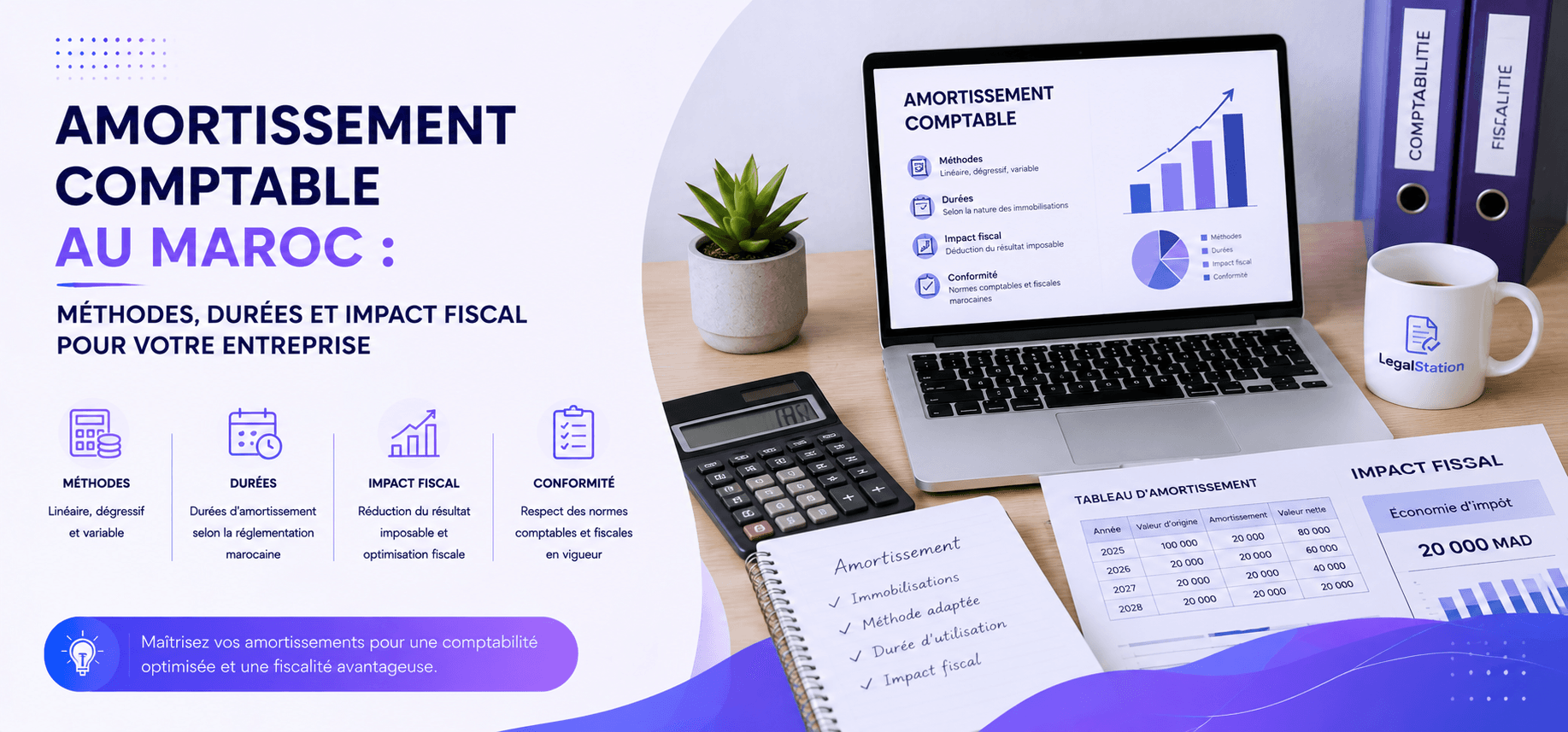
Introduction
Your business has just invested in IT equipment, a commercial vehicle or management software. You may be wondering: how should I record this purchase in the accounts? Over how many years can I depreciate it? Will this reduce my corporation tax? And what are the consequences if I do not comply with the rules in force in Morocco?
Depreciation is one of the most powerful accounting and tax mechanisms available to an entrepreneur, but also one of the least well understood. Incorrect application of rates or depreciation periods can lead to a tax reassessment or, conversely, cause you to miss out on legitimate tax optimisation. Understanding this tool means protecting your cash flow whilst remaining compliant with the requirements of the Moroccan Directorate General of Taxes (DGI) and the Moroccan General Tax Code (CGI).
LegalStation.ma offers this comprehensive and practical guide to accounting depreciation in Morocco: definitions, accepted methods, tax-recognised depreciation periods, the impact on your taxable profit, and mistakes to avoid. Whether you are the director of a limited liability company (SARL), a sole trader transitioning to a more formal business structure, or the head of a growing SME, this guide is for you.
What is depreciation? Definition and basic principles
The concept of depreciation in Moroccan accounting
Depreciation is the accounting recognition of the loss in value of a fixed asset due to wear and tear, the passage of time or obsolescence. In practical terms, when you purchase a durable asset — a machine, a vehicle, office furniture — you cannot deduct its cost in a single go. You spread the cost over its expected useful life, recording a ‘depreciation charge’ each year.
The Moroccan General Chart of Accounts (PCGM) governs this practice. Depreciation is mandatory for any fixed asset with a useful life of more than one year and a value exceeding a threshold deemed significant. Low-value assets may be expensed directly in the financial year in accordance with standard accounting practices, within the limits permitted by the tax authorities.
Which assets are depreciable?
The following are generally depreciable in Morocco:
- Tangible fixed assets: plant and machinery, vehicles, office furniture, fixtures and fittings, buildings and structures.
- Intangible fixed assets: computer software, patents, licences, and goodwill in certain cases.
- Financial fixed assets: these are not depreciable in the strict sense (they are subject to provisions for impairment).
Please note: land is not depreciated, as it does not lose value through use. Only the buildings erected on such land are depreciable.
Depreciation methods accepted in Morocco
Straight-line depreciation: the standard method
The straight-line (or constant) method is the most widely used and the simplest. It involves spreading the asset’s acquisition cost evenly over its useful life. The annual depreciation charge is calculated as follows:
Annual depreciation charge = Original value × Depreciation rate
The rate is the inverse of the useful life: an asset depreciated over 5 years will have a straight-line rate of 20 per cent per annum. This method is systematically recognised by the Moroccan tax authorities and forms the basis for any potential tax adjustments.
Declining-balance depreciation: an advantage in the early years
The Moroccan General Tax Code also permits declining-balance depreciation for certain categories of assets, notably equipment and machinery acquired new with a depreciation period of three years or more. This method allows for higher depreciation charges at the start of the asset’s useful life, which accelerates the tax deduction and preserves cash flow during the first few years of operation.
The declining balance rate is calculated by applying a multiplier to the straight-line rate:
- Useful life of 3 or 4 years: multiplier of 1.5
- Depreciation period of 5 or 6 years: multiplier of 2
- Depreciation period of more than 6 years: multiplier of 3
The option for declining-balance depreciation must be exercised from the first year of the asset’s use and stated in the tax return. It cannot be changed once depreciation has commenced.
Accelerated depreciation and special cases
Under certain conditions set out in the General Tax Code (CGI), particularly in the context of industrial acceleration zones (formerly free zones) or for specific sectors, accelerated depreciation schemes may apply. It is recommended that you consult a chartered accountant or contact LegalStation.ma to check whether your sector is eligible for these specific schemes, which change regularly in line with annual finance acts.
Tax-deductible depreciation periods recognised in Morocco
Reference table of standard depreciation periods
The Moroccan General Tax Code (CGI) and the tax rulings of the General Directorate of Taxes (DGI) recognise depreciation periods that vary according to the nature of the asset. The following are the generally accepted periods, for guidance only:
- Structures (industrial and commercial buildings): 20 to 40 years
- Industrial plant and machinery: 5 to 10 years
- IT equipment and peripherals: 3 to 5 years
- Computer software: 2 to 5 years
- Passenger and commercial vehicles: 4 to 5 years
- Office furniture and fittings: 5 to 10 years
- Patents and licences: depending on the statutory term of protection or the actual period of use
These periods are not set out in a single piece of legislation but result from a combination of the PCGM, administrative doctrine and Moroccan tax case law. Where a company adopts an atypical period, it must justify this on the basis of objective factors (actual wear and tear, technological cycles, operating conditions).
The specific case of passenger cars
Passenger cars are subject to a specific tax rule in Morocco: the depreciable value is capped at 300,000 dirhams (including VAT) per vehicle (except for companies whose main business is transport). Above this ceiling, the excess depreciation allowance is added back to the taxable profit and does not qualify for any tax relief. This is often a source of tax adjustments during tax audits.
LegalStation advice: If you are planning to purchase a vehicle worth more than 300,000 DH for your business, consider leasing. In this case, the lease payments are deductible as operating expenses, without being subject to the cap applicable to depreciation on vehicles purchased outright. This approach can generate substantial tax savings over the term of the contract, provided that business use is clearly documented.
Tax implications of depreciation: Corporation Tax and Income Tax
Reduction in taxable profit
The primary benefit of depreciation is tax-related: depreciation charges reduce the accounting profit and therefore the taxable base for Corporation Tax or Income Tax for sole traders. The more accurately your assets are depreciated, the more your tax liability is legally optimised.
Simplified example: a limited liability company (SARL) makes a gross profit of 500,000 DH. It has recorded depreciation charges of 80,000 DH. Its taxable profit is reduced to 420,000 DH, which automatically reduces the amount of corporation tax due. Over several financial years, this cumulative effect is significant for cash flow.
Deferred depreciation: an option worth knowing about
When a company is operating at a loss, it may choose to carry forward depreciation allowances to subsequent profitable financial years. This is known as deferred depreciation. This option, permitted by the Moroccan tax authorities subject to certain conditions, allows the company to retain its right to a tax deduction for the years in which it is profitable. Please note, however, that this practice requires impeccable record-keeping and precise monitoring within the tax return.
Common mistakes to avoid
Failing to start depreciation from the date of commissioning
Depreciation runs from the date the asset is actually put into service, not from its date of acquisition or delivery. A common mistake is to start depreciating too early or too late. In the event of an audit, the tax authorities may reject depreciation charges that are incorrectly allocated to the relevant financial year.
Applying non-compliant rates
Applying a depreciation rate higher than that permitted for tax purposes — for example, depreciating a vehicle over 2 years instead of 4 or 5 years — will result in the excess being added back to the taxable profit during an audit. The difference between the accounting depreciation and the tax-deductible depreciation must always be analysed and justified.
Overlooking intangible assets
Software, development costs and certain intangible assets are often overlooked or incorrectly classified. They deserve special attention, particularly in the age of digital transformation, where intangible investments are becoming increasingly significant.
Frequently Asked Questions
Can I depreciate an asset acquired under a lease?
No, in principle. Under a lease agreement in Morocco, the asset remains legally the property of the finance company until the purchase option is exercised. It is therefore the lessor who depreciates the asset. The lessee (your company) deducts the lease payments made as operating expenses. Upon exercising the purchase option, the asset becomes part of your fixed assets and can then be depreciated over its remaining useful life.
Is depreciation compulsory, even if my company is making a loss?
In accounting terms, depreciation is compulsory provided the asset is depreciable. However, for tax purposes, a loss-making company may opt to defer depreciation, which allows it to carry forward the deduction to future profitable financial years. This is a strategic option that should be discussed with your tax adviser.
What happens if I dispose of an asset before the end of its depreciation period?
If a fixed asset is sold before the end of its depreciation period, a net book value (NBV) remains. If the sale price is higher than this NBV, you realise a taxable capital gain. If the price is lower, you recognise a deductible capital loss. These transactions must be correctly recorded in your accounting entries and your tax return.
Can I capitalise on renovation work carried out on rented premises?
Yes, subject to certain conditions. Fittings and improvements carried out on rented premises may be capitalised and depreciated over the probable term of the lease or over the useful life of the work, whichever is shorter. The nature of the work and its link to business operations must be documented in detail.
Checklist: Accounting depreciation in Morocco
Phase 1 — On acquisition of the asset
- Determine whether the asset is depreciable (useful life > 1 year, significant value)
- Determine the initial carrying amount (purchase price + incidental acquisition costs)
- Select the depreciation method (straight-line or declining balance) from the first year
- Record the fixed asset record with the date of acquisition and the date of commissioning
Phase 2 — Each financial year
- Calculate the depreciation charge according to the chosen method and rate
- Check compliance with the ceiling of 300,000 DH (including VAT) for passenger cars
- Identify any deferred depreciation if the financial year shows a loss
- Post the accounting entries for the depreciation charge
Phase 3 — At the end of the financial year and in preparation for a tax audit
- Reconcile the accounting depreciation with the tax-deductible depreciation
- Complete the fixed assets and depreciation table in the tax return
- Retain purchase invoices and maintenance or leasing contracts
- Document any unusual durations with a supporting note
- Anticipate capital gains or losses in the event of the disposal or scrapping of an asset
Conclusion
Depreciation is not merely an accounting formality: it is a genuine tool for financial management and tax optimisation for your business in Morocco. When applied correctly, it enables you to accurately reflect the economic reality of your business assets whilst legally reducing your taxable base for corporation tax or income tax. If poorly managed, it exposes your business to avoidable tax assessments and distortions in your financial statements. Understanding the permitted depreciation periods, choosing the right method from the moment the asset is acquired, and documenting every decision are the cornerstones of rigorous management of your fixed assets.
If you wish to ensure the sound accounting and tax management of your assets, or if you have any doubts about the depreciation already applied within your business, LegalStation.ma can direct you to the right experts. Our team supports Moroccan entrepreneurs at every stage of their development — from setting up a business to optimising their financial structure — so that every decision is made with a full understanding of the applicable rules.
Prêt à lancer votre activité au Maroc ?
Legalstation vous accompagne de A à Z : SARL, SAS, SA ou auto-entrepreneur. Statuts, immatriculation RC et suivi expert.
Commentaires
Soyez le premier à commenter cet article.