


Prêt à lancer votre activité au Maroc ?
Legalstation vous accompagne de A à Z : SARL, SAS, SA ou auto-entrepreneur. Statuts, immatriculation RC et suivi expert.
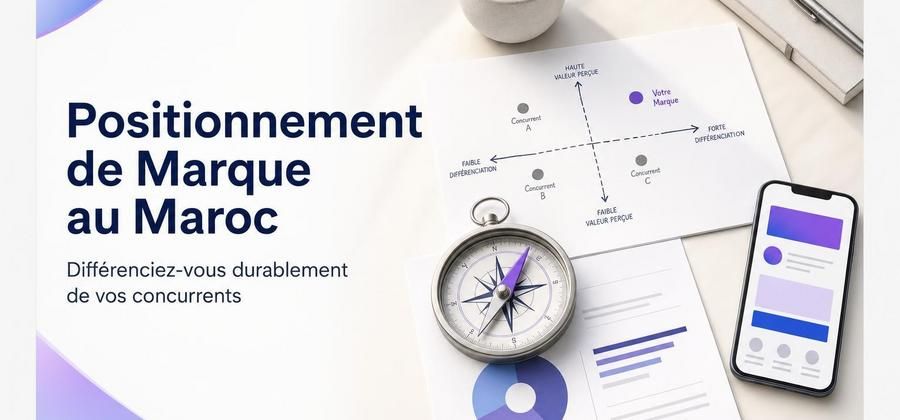
Why do some Moroccan businesses naturally attract clients while others struggle to get noticed, even with quality products? What sets a brand that stays top of mind apart from one that fades into the crowd? How can you tell whether your current positioning is actually perceived by your target clients, or whether it only exists in your own mind? These are questions most Moroccan entrepreneurs ask themselves at some point — often too late.
Brand positioning is one of the most powerful and most underestimated marketing levers in the Moroccan entrepreneurial landscape. It is not a slogan, a logo, or a visual identity. It is the place your business occupies in the minds of your clients — the reason they choose you over a competitor. In an increasingly saturated market, regardless of your industry, a vague positioning is synonymous with commercial invisibility.
This comprehensive guide, brought to you by LegalStation.ma, walks you through every step of building or refining a brand positioning that is consistent, credible, and differentiating — tailored to the realities of the Moroccan market.
What exactly is brand positioning?
Brand positioning refers to the way a business wants to be perceived by its target clients, relative to its competitors. It is a clear, consistent, and distinctive promise made to a specific market segment.
It answers one fundamental question:why should a client choose you over anyone else?
Effective positioning rests on three pillars:
- The target:who exactly are you speaking to?
- The promise:what unique value do you deliver?
- The proof:what underpins your credibility?
Positioning is not what you think you are — it is what your clients actually perceive. That is why it must be developed methodically, not left to chance.
Why positioning is critical for Moroccan entrepreneurs
The Moroccan market is undergoing profound transformation. Accelerating digitalization, the rise of e-commerce, the influx of international brands, and an increasingly organized local competitive landscape have made differentiation essential.
Without clear positioning, you are forced to compete on price alone — a race to the bottom that erodes your margins and undermines your business in the long run.
Conversely, strong positioning enables you to:
- Attract the right clients — those who genuinely value what you offer
- Justify your prices without apology
- Build lasting customer loyalty
- Drive all your marketing decisions with consistency
- Withstand competitive pressure
Four steps to building a solid brand positioning
Step 1: Analyze your market and your competitors
Before positioning yourself, you need to understand the landscape. Identify the key players in your sector in Morocco: their strengths, weaknesses, communications, pricing, and customer base.
Ask yourself the right questions:
- On what criteria are my competitors positioning themselves? (price, quality, speed, proximity, prestige…)
- Which market spaces are underoccupied?
- What customer needs remain unmet?
This analysis allows you to identify genuine differentiation opportunities — not just ones that seem obvious internally.
Step 2: Define your target precisely
Effective positioning speaks to a specific segment, not everyone. Trying to appeal to everyone is a guaranteed way to convince no one.
Define your ideal client by going beyond basic demographic data. Consider:
- Their deeper motivations
- Their current frustrations
- Their purchasing decision criteria
- Their consumption habits in Morocco
In the Moroccan context, it is important to account for cultural specificities, regional variations (Casablanca, Marrakech, Tangier, secondary cities), and behavioral differences between French-speaking, Arabic-speaking, and Amazigh-speaking segments, depending on your line of business.
Step 3: Identify your differentiating advantage
Your differentiating advantage is what you do better than anyone else — or differently — and that holds genuine value for your target audience.
It can be grounded in several dimensions:
- Quality:materials, finishes, technical expertise
- Service:responsiveness, support, personalization
- Customer experience:seamlessness, emotion, trust
- Origin:local know-how, Moroccan-made products, short supply chains
- Price:superior value for money or an assumed premium positioning
- Innovation:technology, new approaches, digitalization
Note: your differentiator must be real, perceptible by the client, and difficult to replicate in the short term.
Step 4: Formulate your positioning statement
Once your analysis is complete, formalize your positioning in a clear internal statement. This is not an advertising tagline — it is a strategic management tool.
The classic structure is as follows:
For [specific target], [your brand name] is the [category] that [unique benefit] because [proof of credibility].
Fictional example adapted to Morocco: "For growing SMEs in Casablanca, MonService is the online accounting solution that simplifies Moroccan tax management because it was designed by certified accountants based in Morocco."
This statement will serve as your compass for all marketing, sales, and communications decisions.
Translating your positioning into concrete actions
Positioning remains theoretical if it is not embodied at every touchpoint with your clients. Here is how to deploy it consistently.
On your website and social media
Your positioning must be visible within the first few seconds. Your website homepage, your Instagram or LinkedIn bio, and your Google My Business profile should immediately reflect your promise and your target audience.
Avoid vague formulations such as "quality, seriousness, professionalism." Be specific. "Delivery within 24 hours anywhere in Casablanca" is a positioning. "Quality service" is not.
In your pricing policy
Your price is a positioning signal. A business positioning itself as premium cannot charge below-market rates without muddying its image. Conversely, an accessible positioning must be backed by rigorous cost management.
In your client relationships
The way you respond to messages, handle complaints, welcome clients to your premises, or write your emails must be consistent with your brand promise. Every interaction is an opportunity to either confirm or betray your positioning.
The most common positioning mistakes in Morocco
- Overly broad positioning:trying to reach all audiences dilutes your message and weakens its impact.
- Unstable positioning:shifting your narrative based on opportunities creates confusion among clients.
- Undifferentiated positioning:copying a competitor's message makes you invisible on their own turf.
- Positioning disconnected from reality:promising what you cannot deliver destroys trust faster than any crisis.
- Overlooking Moroccan cultural context:some positioning strategies imported from Europe or the United States do not resonate in the same way with Moroccan consumers.
Evolving your positioning without losing consistency
Positioning is not set in stone. It can evolve alongside your market, your offerings, or your ambitions. But that evolution must be gradual and controlled.
Before adjusting your positioning, assess:
- Your current image as perceived by clients (surveys, reviews, field feedback)
- Emerging market opportunities
- Your genuine capacity to deliver on the new promise
An abrupt repositioning — without preparation or communication — can unsettle your existing clientele and damage your reputation.
LegalStation tip:Before rolling out a new brand positioning, make sure your trade name, domain name, and visual assets are properly protected from a legal standpoint. In Morocco, registering your trademark with the OMPIC (Office Marocain de la Propriété Industrielle et Commerciale) is an essential step to safeguard your brand identity and prevent unauthorized use by competitors. A strong positioning deserves equally strong legal protection.
Frequently asked questions
What is the difference between brand positioning and visual identity?
Visual identity (logo, colors, typography) is the graphic expression of your positioning — it is not the positioning itself. Your positioning is a strategic promise in the minds of your clients. Visual identity is one of the tools that communicates it, but it is not sufficient on its own.
My business is small. Is positioning really useful for me?
Yes — arguably even more so. A small business cannot afford to waste resources by trying to speak to everyone. A precise positioning allows you to concentrate your marketing efforts where they will have the greatest impact, even on a limited budget. It is a competitive advantage you can build without massive investment.
How can I tell whether my positioning is being perceived correctly by my clients?
The most effective method is to ask your clients directly. Short interviews, a simple questionnaire, or an analysis of your online reviews will allow you to compare actual perception with your strategic intent. If the gap is significant, it is a sign that your communications need to be adjusted.
Can a business have multiple positionings for different product lines?
It is possible to adapt positioning by segment or product range, but all positioning must remain consistent with your overall brand image. If the positioning of your different offerings becomes too inconsistent, it can undermine the clarity of your business. In that case, consider creating distinct sub-brands.
How long does it take for a positioning to be recognized in the market?
Positioning is built over time. Marketing experts generally estimate that it takes between 12 and 24 months of consistent, sustained communication for a positioning to truly take root in the minds of consumers. Consistency is the key.
Checklist
- Analyze the current positioning of your 3 to 5 main competitors in Morocco
- Identify underoccupied or poorly served market spaces in your sector
- Clearly define your target client, including their motivations, frustrations, and purchasing criteria
- Identify your real and verifiable differentiating advantage
- Draft your internal positioning statement (target, promise, proof)
- Verify that your positioning is consistent with your pricing policy
- Align your website, social media, and marketing materials with your positioning
- Train or brief your team on the brand promise to ensure consistency in client interactions
- Collect regular client feedback to measure actual perception of your positioning
- Protect your brand name by registering it with the OMPIC
- Schedule an annual review of your positioning to adapt it to market developments
Conclusion
Brand positioning is not a luxury reserved for large corporations. It is a strategic tool accessible to any Moroccan entrepreneur, regardless of the size of their business. When well-defined, it becomes your commercial compass: guiding your marketing decisions, clarifying your message, attracting the right clients, and providing lasting protection against competition. In a rapidly evolving economic environment in Morocco, the businesses that endure are those that know exactly what they stand for and who they serve.
Building a solid positioning takes time, reflection, and a degree of discipline. But the long-term benefits are considerable. If you wish to go further in structuring your marketing strategy or securing the legal foundations of your brand, LegalStation.ma provides practical resources and expert guidance to support you at every stage of your development.
Prêt à lancer votre activité au Maroc ?
Legalstation vous accompagne de A à Z : SARL, SAS, SA ou auto-entrepreneur. Statuts, immatriculation RC et suivi expert.
Commentaires
Soyez le premier à commenter cet article.