


Prêt à lancer votre activité au Maroc ?
Legalstation vous accompagne de A à Z : SARL, SAS, SA ou auto-entrepreneur. Statuts, immatriculation RC et suivi expert.
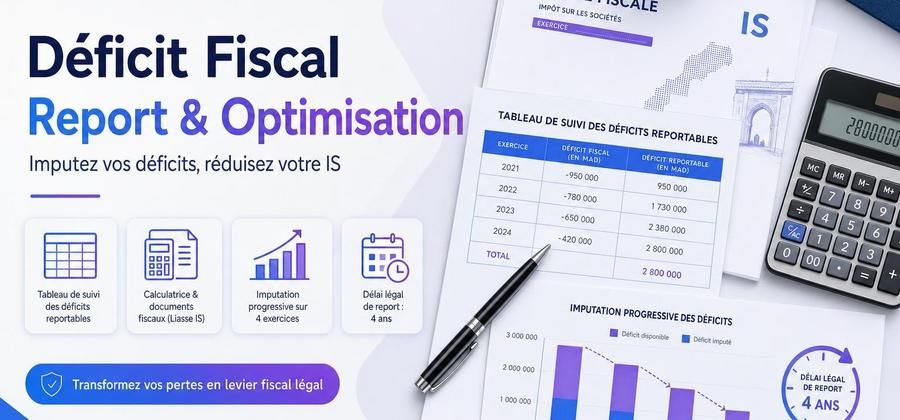
Your company closed a fiscal year with a negative result. Can you recover this tax advantage in subsequent years? How does loss carry-forward work in Morocco? Is there a time limit? And what mistakes could cause you to lose this valuable right?
A tax deficit is a common reality in a company's life, particularly during the start-up phase, in the event of an economic downturn, or following a significant capital investment. When properly managed, it represents a legitimate tax lever that can reduce corporate income tax (IS) in years of recovery. When misunderstood or incorrectly declared, however, it can turn into a dispute with the General Directorate of Taxes (DGI).
LegalStation presents this comprehensive guide to understanding the tax loss carry-forward mechanism in Morocco, the rules that govern it, and best practices for benefiting from it in full compliance.
What Is a Tax Deficit in Morocco?
A tax deficit arises when a company's taxable result — after extra-accounting adjustments — is negative at the close of a fiscal year. It should not be confused with the accounting result, as the two can differ significantly.
Accounting Result vs. Taxable Result
The accounting result is determined in accordance with the rules of the Moroccan General Chart of Accounts (PCGM). The taxable result, on the other hand, is derived after fiscal add-backs and deductions provided for under the Moroccan General Tax Code (CGI). Expenses that are acceptable from an accounting standpoint may not be tax-deductible, and vice versa. It is this taxable result — not the accounting result — that serves as the basis for calculating IS.
Why a Tax Deficit May Arise
Several situations can generate a tax deficit:
- Start-up phase with significant expenses and limited turnover
- High depreciation charges linked to investments in equipment or commercial real estate
- Economic downturn affecting the company's revenues
- Significant provisions recorded and fiscally deductible
- Financial charges related to substantial debt
Tax Loss Carry-Forward in Morocco: Legal Framework
The Moroccan General Tax Code expressly authorizes the carry-forward of tax losses to subsequent profitable fiscal years. This mechanism applies to companies subject to corporate income tax (IS).
The Four-Year Rule
Under Moroccan tax law, a loss recorded in a given fiscal year may be deducted from the taxable profit of the four subsequent fiscal years. This rule is fundamental: beyond four years, any unabsorbed deficit is permanently forfeited. It can no longer be used to reduce IS.
In practical terms, if your company records a tax deficit in 2022, that deficit must be offset against the taxable profits of fiscal years 2023, 2024, 2025, and 2026 at the latest. Once that period has elapsed, it falls under the statute of limitations.
Exception: Deficits Arising from Depreciation
Moroccan law provides for an important exception: the portion of the tax deficit that corresponds to regularly recorded depreciation allowances may be carried forward indefinitely. In other words, this fraction of the deficit is not subject to the four-year limit.
This distinction is strategically significant for companies that have made substantial investments. It allows for an unlimited carry-forward on the depreciation portion, even if the remainder of the deficit is subject to the four-year deadline.
Order of Offsetting
Offsetting must follow a precise chronological order. The oldest deficit is applied first. This prevents recent deficits from being used before older ones expire. Compliance with this order is verified during tax audits.
How to Declare and Offset a Tax Deficit
In the Tax Return Package
The carried-forward tax deficit is declared in the annual tax return package filed with the DGI. It appears in the taxable result determination schedule, with a clear breakdown between:
- The portion of the deficit arising from depreciation (carry-forward without time limit)
- The portion of the deficit excluding depreciation (carry-forward limited to four fiscal years)
This distinction must be precisely documented and substantiated in your financial statements. A chartered accountant plays a key role here in preventing any misclassification errors.
Offsetting Against Profitable Fiscal Years
When your company generates a taxable profit in a subsequent fiscal year, the carried-forward deficit is deducted before IS is calculated. The offset thereby directly reduces the taxable base and, consequently, the amount of tax payable.
Here is a simplified example:
- Tax deficit 2022: MAD 300,000 (of which MAD 120,000 relates to depreciation)
- Taxable profit 2023: MAD 200,000
- Offset of 2022 deficit against 2023: MAD 200,000 absorbed, remaining balance: MAD 100,000
- IS base 2023: MAD 0 (no IS due for this fiscal year)
The remaining balance of MAD 100,000 will be carried forward to fiscal years 2024, 2025, and 2026.
Tax Deficit and Minimum Contribution: A Subtle but Important Point
In the event of a tax deficit or insufficient profit, the minimum contribution (CM) remains due. The minimum contribution is a floor tax calculated on pre-tax turnover and certain other revenues, regardless of the taxable result. Even if the loss carry-forward reduces your IS base to zero, you may still be liable for the minimum contribution if it exceeds the theoretical IS amount.
This point is often misunderstood by company directors: carrying forward a deficit does not necessarily exempt a company from paying a minimum level of tax. Tax planning must therefore incorporate this constraint.
Mistakes to Avoid at All Costs
Failing to Properly Allocate the Deficit
Failing to distinguish the depreciation portion from the non-depreciation portion is a common mistake. It can cause you to lose the benefit of the unlimited carry-forward on the depreciation fraction, or conversely expose your company to a tax reassessment if the DGI challenges your classification.
Forgetting to Declare the Carry-Forward in the Tax Return Package
The loss carry-forward does not apply automatically. It must be expressly declared and stated in the tax return package. An omission or declaration error can result in the loss of the right to deduction.
Failing to Respect the Chronological Order of Offsetting
Applying recent deficits before older ones is contrary to the legal rule. This can result in the forfeiture of the oldest deficits as they reach expiry, as well as adjustments during a tax audit.
Confusing Tax Deficit with Accounting Deficit
Companies with a negative accounting result may sometimes generate a positive taxable result, and vice versa. Using the accounting result as the basis for carry-forward would be a serious error that could lead to an incorrect tax filing.
LegalStation Advice:If your company has experienced several consecutive loss-making years, establish a deficit tracking schedule now, recording for each fiscal year: the total deficit amount, the depreciation portion, the non-depreciation portion, amounts already offset, and expiry dates. This tax dashboard will enable you to manage your offsets with precision and anticipate the fiscal years in which a deficit will be permanently forfeited. A chartered accountant or tax adviser can help you build and maintain it.
Tax Deficit and Tax Audits: What You Need to Know
Carried-forward deficits are a particular focus of attention during tax audits conducted by the DGI. Inspectors specifically verify:
- The reality and legitimacy of the expenses that generated the deficit
- The correct allocation between depreciation and ordinary expenses
- Compliance with the chronological order of offsetting
- Consistency between declared deficits and annual financial statements
Thorough documentation — contracts, invoices, depreciation schedules, minutes of general meetings — is essential to justify the origin of deficits in the event of an audit.
Frequently Asked Questions
Can a Tax Deficit Be Carried Back in Morocco?
No. Moroccan tax law does not provide for loss carry-back. Unlike certain countries that allow a deficit to be offset against profits from prior fiscal years in order to obtain a refund of IS, in Morocco only the carry-forward to four subsequent fiscal years is permitted — except for the depreciation portion, which may be carried forward indefinitely.
Does the Four-Year Rule Apply to Self-Employed Individuals (Auto-Entrepreneurs)?
No. The auto-entrepreneur regime in Morocco is subject to a flat-rate tax calculated on turnover, with no concept of taxable result or loss carry-forward. This mechanism applies exclusively to companies subject to IS or to income tax (IR) under the actual net profit or simplified net profit regime.
Can a Tax Deficit Be Offset Against Other Types of Income?
Under the IS regime, a company's tax deficit is strictly offset against its own future taxable profits. It cannot be transferred to another entity, except in very specific cases of merger or restructuring, which are governed by particular tax rules.
What Happens If the Deficit Is Not Fully Offset Within the Four-Year Period?
The non-depreciable portion of the deficit that has not been offset within the four subsequent fiscal years is permanently forfeited. It can no longer be deducted for tax purposes. Only the portion corresponding to regular depreciation allowances may continue to be carried forward beyond this limit.
Does a Tax Deficit Reduce IS Provisional Instalments?
IS provisional instalments are calculated on the basis of IS from the previous reference fiscal year. If the tax deficit reduces IS in a given year to zero, this may impact the calculation of instalments for the following year. It is advisable to analyse this impact with your chartered accountant in order to optimize your cash flow.
Checklist
- Identify the taxable result: calculate the fiscal year's taxable result after all extra-accounting adjustments, independently of the accounting result
- Allocate the deficit: clearly distinguish the portion of the deficit arising from depreciation (unlimited carry-forward) from the non-depreciation portion (carry-forward limited to 4 fiscal years)
- Create a tracking schedule: for each loss-making fiscal year, record the amount, the allocation, offsets already applied, and the expiry date
- Declare the carry-forward in the tax return package: ensure that the carry-forward deficit is correctly stated in the tax forms filed with the DGI
- Respect the order of offsetting: always apply the oldest deficits first to prevent their forfeiture
- Anticipate the minimum contribution: verify whether the CM remains due despite the loss carry-forward and plan the corresponding cash outflow
- Document the expenses at the origin of the deficit: retain all supporting documents (invoices, contracts, depreciation schedules) in anticipation of a potential tax audit
- Consult a chartered accountant: have the offsetting strategy and compliance of declarations validated by a qualified professional
- Monitor expiry deadlines: set up annual alerts to ensure that no imputable deficit is ever allowed to lapse
Conclusion
Tax loss carry-forward is a legal mechanism that is often underutilised by Moroccan entrepreneurs, due to a lack of understanding of its precise rules. When properly mastered, it can significantly reduce the IS burden in subsequent profitable years, improve the company's cash flow, and legally optimise its tax position. The key lies in a rigorous allocation between depreciable and non-depreciable deficits, annual monitoring of expiry deadlines, and compliant reporting in the tax return package.
To go further in managing your company's tax affairs, LegalStation provides practical resources and expert guidance to support your decision-making. Do not hesitate to consult our blog or engage our services to secure your tax compliance and optimise your strategy within the Moroccan legal framework.
Prêt à lancer votre activité au Maroc ?
Legalstation vous accompagne de A à Z : SARL, SAS, SA ou auto-entrepreneur. Statuts, immatriculation RC et suivi expert.
Commentaires
Soyez le premier à commenter cet article.