


Prêt à lancer votre activité au Maroc ?
Legalstation vous accompagne de A à Z : SARL, SAS, SA ou auto-entrepreneur. Statuts, immatriculation RC et suivi expert.
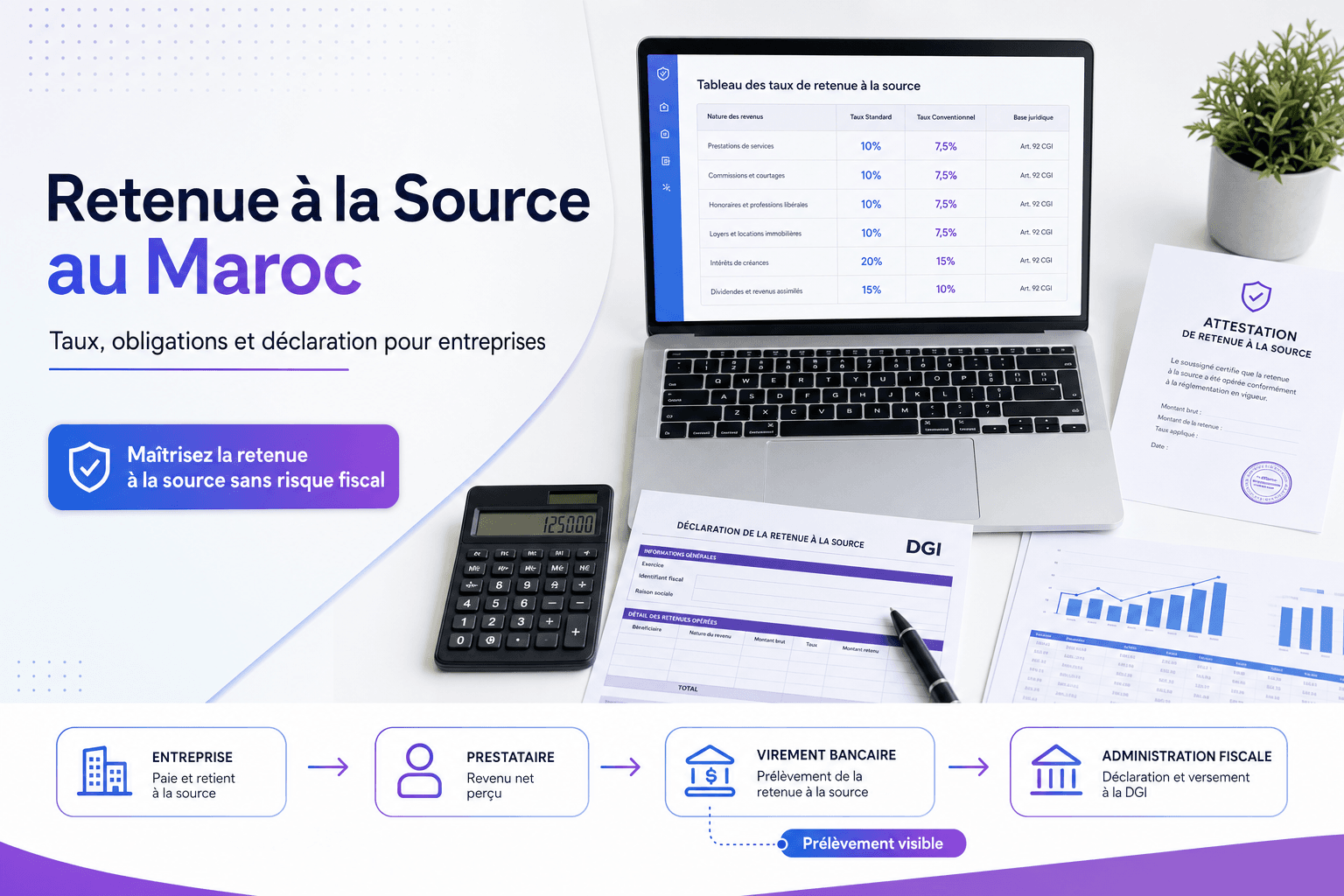
You have just signed a contract with an independent contractor or a foreign company and you are wondering whether you need to withhold a portion of the payment before transferring the funds. You are the director of an LLC and you are unsure whether dividends paid to your shareholders are subject to a mandatory withholding. You have heard of withholding tax but are not quite sure who it applies to or how to report it. These questions are common among Moroccan business owners, and mistakes in this area can be costly.
Withholding tax is a tax collection mechanism under which the company making a payment becomes a tax collector on behalf of the State. In practice, it is you — as the payer — who deduct the tax directly from the amount paid before transferring it to the recipient. This system covers a wide range of situations: fees paid to service providers, distributed dividends, investment income, and payments to non-residents. Poor compliance exposes businesses to tax reassessments, penalties, and late-payment interest.
To help business leaders and financial managers gain a clear understanding of the subject, LegalStation has produced this comprehensive guide to withholding tax in Morocco: how it works, applicable rates, declaration procedures, and common mistakes to avoid.
What Is Withholding Tax in Morocco?
Withholding tax is a method of tax collection provided for under Morocco's General Tax Code (CGI). Rather than the income recipient declaring and paying their own tax, it is the paying party — known as the withholding debtor — who deducts the tax at source and remits it directly to the tax authorities.
This mechanism serves two main objectives:
- Securing tax collection by reducing the risk of non-payment.
- Simplifying the declaration process for certain categories of taxpayers.
For the company making the payment, this withholding constitutes a standalone tax obligation, separate from its own taxes. Failure to comply with this obligation engages the company's liability, even if the income recipient is otherwise fully compliant with their own tax obligations.
Who Is Subject to Withholding Tax?
Companies Subject to Corporate Income Tax
Any company subject to corporate income tax (IS) in Morocco may be liable as a withholding debtor when it pays certain categories of income. It may also be a withholding recipient when it earns income subject to withholding, in which case the withheld amount is credited against its IS liability.
Individuals and Self-Employed Professionals
Companies that engage independent contractors, consultants, or experts must in certain cases apply withholding tax to the fees they pay. This rule applies in particular when the service provider's income falls within the category of professional income subject to personal income tax (IR).
Foreign Companies Without a Permanent Establishment in Morocco
This is one of the most frequently overlooked situations. When a Moroccan company makes payments to a foreign company that has no permanent establishment in Morocco — whether for services, royalties, copyright fees, or interest — it is required to apply withholding tax before making any payment.
The Main Categories of Income Subject to Withholding Tax
Dividends and Profit Distributions
When a company distributes profits to individual shareholders who are Moroccan residents, withholding tax applies to those dividends. The applicable rate is generally set at15%. This rate may be reduced or waived under an applicable international tax treaty where the shareholder is a non-resident.
Fixed-Income Investment Products
Interest paid on deposits, treasury bonds, bonds, or other financial instruments is also subject to withholding tax. The rate varies depending on the nature of the investment and the status of the recipient (individual or legal entity, resident or non-resident).
Fees, Commissions, and Service Provider Remuneration
Amounts paid to individuals or legal entities in respect of services rendered fall within the scope of withholding tax in a number of situations. It is necessary to assess on a case-by-case basis whether the service provider qualifies for an exemption or a reduced rate.
Payments Made to Non-Residents
This is a critical compliance point for Moroccan companies that outsource work internationally. Royalties for software use, licence fees, and intellectual services provided by foreign companies with no presence in Morocco are subject to withholding tax at a standard rate that may reach10%, subject to any bilateral tax treaties signed by Morocco.
Withholding Tax Rates: Summary Table
Important:These rates are provided for indicative purposes based on the Moroccan CGI. They may be amended by annual finance laws or reduced by bilateral tax treaties. It is strongly recommended that you verify the rates currently in force with a tax adviser before carrying out any transaction.
How to Declare and Remit Withholding Tax
The Declaration Deadline
The company liable for the withholding must remit the withheld amounts to the Trésorerie Générale du Royaume within a specified deadline following the month in which the withholding was applied. This deadline is generally set at the31st of the following monthafter the payment is made. Any delay results in penalties and surcharges.
Declaration Forms and Channels
Withholding tax declarations are filed using the forms made available by the Direction Générale des Impôts (DGI). Online filing is now mandatory for most companies subject to IS, via the DGI'sSimpl.taxportal. Companies must enter the gross amount paid, the rate applied, and the amount withheld.
The Withholding Tax Certificate
After applying the withholding, the company must issue the recipient with awithholding tax certificate. This document enables the recipient to claim the corresponding tax credit when filing their own tax return. Failing to issue this certificate is a common mistake that can give rise to disputes with the service provider or shareholder concerned.
Bilateral Tax Treaties: A Decisive Factor
Morocco has signed tax treaties with numerous partner countries, including France, Spain, Gulf states, and several African nations. These treaties often provide for withholding tax rates lower than the standard domestic rates, or even full exemptions in certain cases.
Before making a payment to a foreign service provider or partner, it is therefore essential to verify:
- Whether a tax treaty exists between Morocco and the recipient's country of residence.
- What rate that treaty provides for the type of income concerned.
- Whether the recipient can provide a tax residency certificate in order to benefit from the treaty.
Applying the standard domestic rate without checking whether a treaty exists may lead to double taxation and damage your commercial relationship with the foreign service provider.
The Most Common Mistakes Made by Moroccan Businesses
- Failing to apply withholding on payments to non-residents, under the mistaken assumption that it is the foreign party's responsibility to manage their own tax affairs.
- Confusing the gross amount with the net amount: withholding must be calculated on the gross amount of the income, before any deductions.
- Forgetting to issue the withholding tax certificateto the recipient.
- Remitting the withholding tax after the deadline, exposing the company to penalties.
- Failing to check applicable tax treatiesand over-withholding, which complicates commercial relationships.
- Confusing withholding tax with VAT: these are two distinct mechanisms that may apply simultaneously to the same invoice.
LegalStation Tip:If you regularly outsource work to freelancers, consultants, or foreign companies, put a simple internal procedure in place: before making any first payment, verify the tax status of the service provider, the nature of the income being paid, the applicable treaty if any, and document the withholding in your accounts. A simple checklist by supplier type can help you avoid costly reassessments during a tax audit.
Frequently Asked Questions
Is withholding tax calculated on the VAT-inclusive or VAT-exclusive amount?
Withholding tax is in principle calculated on theVAT-exclusiveamount of the income paid. VAT, where applicable, is a separate tax governed by its own collection and declaration rules. The two mechanisms must not be conflated.
What happens if a company fails to apply withholding tax?
The tax authorities may claim the amount of the withholding that was not applied directly from the liable company, plus penalties and late-payment interest. The company therefore bears the cost of its own non-compliance, even if the income recipient has paid their own tax separately. This risk is particularly significant during a tax audit.
Is a Moroccan self-employed entrepreneur subject to withholding tax?
The self-employed entrepreneur regime in Morocco provides for a flat-rate tax withheld at source by the client on amounts paid to the self-employed entrepreneur. The rate varies depending on the sector of activity. This mechanism replaces the standard IR declaration for the self-employed entrepreneur, provided that the regime's turnover thresholds are respected.
How can a company recover withholding tax that has been applied to income it receives?
When a company subject to IS has withholding tax applied to income it receives, the withheld amount constitutes a tax credit that can be offset against its IS liability. If this credit exceeds the IS due for the financial year, it may be carried forward to subsequent years or, in certain cases, refunded. The refund procedure requires a formal application to the DGI.
Does withholding tax apply even for small amounts?
The Moroccan CGI does not provide for any exemption threshold below which withholding would not be required, except where specific provisions apply to certain regimes. Once income falls within the scope of withholding tax, it applies regardless of the amount. It is therefore advisable to carry out a systematic check before each payment.
Compliance Checklist
- Before any payment:
- Identify the nature of the income being paid (dividend, fee, royalty, interest, etc.).
- Verify the recipient's status: resident or non-resident, individual or legal entity.
- Check applicable bilateral tax treaties if the recipient is foreign.
- Request a tax residency certificate from the foreign recipient if a treaty applies.
- At the time of payment:
- Calculate the withholding on the gross VAT-exclusive amount.
- Deduct the withheld amount from the payment made to the recipient.
- Record the transaction in the company's accounts.
- After the payment:
- Issue a withholding tax certificate to the recipient.
- File the online declaration via the DGI's Simpl.tax portal.
- Remit the withheld amount to the Trésorerie within the legal deadline.
- Retain all supporting documents (contract, invoice, certificate, proof of payment) for the legally required accounting document retention period.
- At the end of the financial year:
- Compile a summary of all withholdings applied and received.
- Verify the offsetting of withholdings received against the IS liability for the year.
- Ensure consistency between monthly declarations and the annual tax return.
Conclusion
Withholding tax is an essential fiscal mechanism for any Moroccan business that distributes dividends, engages independent service providers, or works with foreign partners. Poor compliance exposes companies to tax reassessments for which they are entirely responsible, even when the income recipient has fulfilled their own obligations. When properly integrated into accounting and financial processes, however, it becomes a straightforward mechanism that does not disrupt day-to-day operations.
If you have any doubts about the rates applicable to your situation, your declaration obligations, or the impact of tax treaties on your international payments, LegalStation is available to assist you with advice tailored to your business and legal structure.
Prêt à lancer votre activité au Maroc ?
Legalstation vous accompagne de A à Z : SARL, SAS, SA ou auto-entrepreneur. Statuts, immatriculation RC et suivi expert.
Commentaires
Soyez le premier à commenter cet article.